Custom Team T-Shirts: How to Order Right Every Time
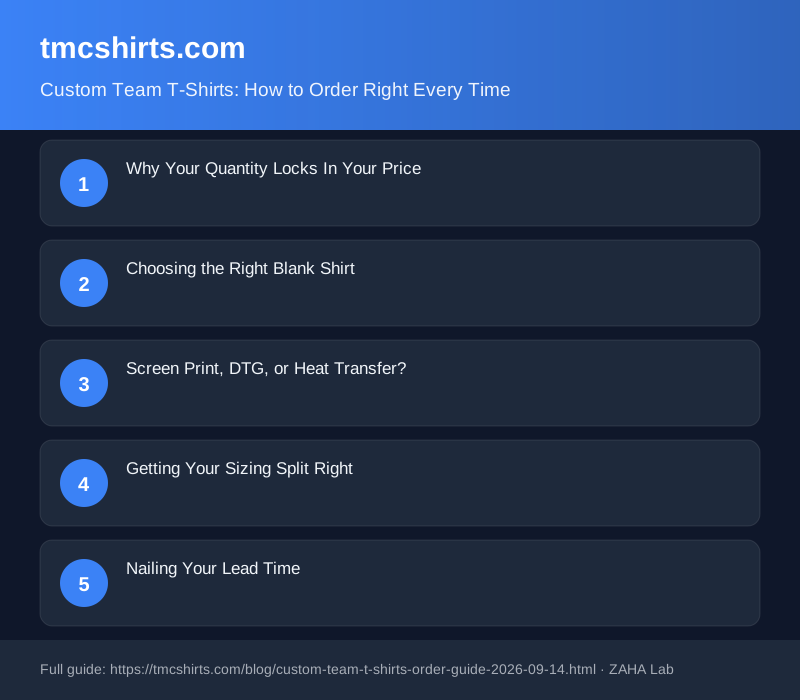
More than 60% of bulk custom t-shirt orders arrive with at least one avoidable problem — wrong sizing, a late delivery, or a print that looks nothing like the proof. Almost every one of those problems starts with a decision made in the first ten minutes of placing an order.
Why Your Quantity Locks In Your Price
Custom t-shirt printing is a volume game. Screen printers create a separate screen for each colour in your artwork, so a 10-shirt run carries almost the same setup cost as a 100-shirt run — but that cost gets spread across far fewer garments. That is why per-unit prices drop sharply at the 24, 48, and 72-shirt thresholds that most UK printers use as standard break points.
Before you request a quote, commit to a firm number rather than a range. "Between 50 and 80" costs you money: printers quote to the lower figure, and adding shirts after the order is placed almost always means surcharges and rescheduling. If you are genuinely unsure of final numbers, order 10% more than you think you need. Spare shirts disappear at events; re-orders never arrive in time.
For large events, ask your printer about garment buyback or credit policies. Some will offset unused sealed stock against your next order, which removes the risk of over-ordering altogether.
Choosing the Right Blank Shirt
The blank shirt you choose determines print quality, longevity, and whether people are still wearing theirs three years later. For most UK team and event use, a 185–200 gsm cotton jersey is the sweet spot: heavy enough to feel quality, light enough for a full day's wear.
A perennial favourite with event organisers is the Gildan Heavy Cotton 5000 — a workhorse blank available in over 60 colours with a flat chest that takes screen-print ink cleanly and consistently. It runs generously in the body, which most teams appreciate.
For sports squads doing high-intensity activity, moisture-wicking polyester blends are worth the step up in cost. They print beautifully with sublimation and will not cling after a warm-up. Whatever blank you choose, request a physical size chart from your printer and share it with your group before you finalise the order.
One rule that saves serious money: always ask for pre-production samples if you are ordering more than 100 shirts. A sample run is a negligible cost compared with reprinting 300 shirts because the "navy" you approved on screen turned out to be closer to charcoal on the actual blank.
Screen Print, DTG, or Heat Transfer?
Print method is the decision most buyers gloss over, yet it affects both cost and quality more than any other single variable.
Screen printing is best for orders of 25 or more shirts with designs using three colours or fewer. It is the most durable option, produces the most vibrant results, and is cheapest per unit at scale. The downside: setup costs make small runs expensive, and photographic or gradient artwork does not translate well to the medium.
Direct-to-garment (DTG) printing works like an inkjet printer on fabric and handles full-colour, photographic designs with no setup fee. It is ideal for one-off commemorative shirts or small charity runs under 20 pieces. Print quality has improved substantially and now rivals screen print on 100% cotton for small orders.
Heat transfer vinyl (HTV) is the fastest option for small squads or last-minute needs, and it lets you customise each shirt individually — perfect for adding player names and squad numbers. If your club wants to handle small top-ups in-house, a starter roll of Siser EasyWeed Heat Transfer Vinyl paired with a basic heat press will cover squad numbering without going back to a printer every season.
A reliable rule of thumb: use screen printing above 50 shirts, DTG below 20, and HTV for individualised small runs or in-house top-ups.
Getting Your Sizing Split Right
Sizing is where well-planned orders fall apart at the last moment. Ordering "10 of each size" sounds fair in the abstract but leaves you with a pile of XXLs and a queue of people who cannot find a medium.
For a typical mixed adult group in the UK, a reliable starting distribution for 100 shirts is roughly: S×10, M×25, L×30, XL×25, XXL×10. Adjust for what you know about your group — a youth football squad skews smaller; a corporate away-day often skews larger.
The simplest fix is a quick sizing survey sent to participants two weeks before you place your order. A Google Form asking for preferred size — with a note linking to the printer's size chart — takes 15 minutes to build and prevents hours of post-event complaints.
If you are ordering a fitted or fashion-cut blank such as the Fruit of the Loom Original, check whether it runs small: some fashion-fit styles sit a full size below their label. One email to your printer before the order is placed is worth a hundred shirt-swapping conversations on the day of the event.
Nailing Your Lead Time
Most UK custom t-shirt printers quote 7–14 working days from artwork approval to dispatch for screen print orders. DTG is faster — some suppliers turn around small runs in 3–5 working days. HTV for small quantities is the fastest of all.
Build your timeline backwards from the event date:
- Day 0 — event date
- −3 days — shirts in your hands; time to check, sort, and distribute
- −5 days — dispatch from printer
- −12 days — artwork approved and order confirmed
- −18 days — design finalised and at least two quotes compared
- −25 days — brief sent to your designer or printer
That 25-day minimum feels generous until a designer goes quiet for a week or artwork gets rejected because the resolution is too low for print. Padding your timeline is not laziness — it is the single most effective stress-reduction technique available when managing a team clothing order.
If you are organising a recurring event, brief your printer the moment last year's event wraps up. Locking in a slot early is often the difference between your preferred printer being available and settling for whoever has capacity.
FAQ
What is the minimum order quantity for custom team t-shirts?
Most UK screen printers require a minimum of 12–24 shirts to justify the setup cost. For DTG printing you can often order a single shirt, though the unit price is significantly higher. If you need fewer than 12 shirts, DTG or heat transfer vinyl will give you the most cost-effective result.
What file format should I supply for my design?
Vector files — AI, EPS, or print-ready PDF — are the gold standard for screen printing because they scale to any size without losing sharpness. If you only have a raster image such as a JPEG or PNG, it should be at least 300 dpi at the intended print size. Most printers will flag any artwork issues at quoting stage before you commit.
Can I order two different colourways or designs in one run?
Yes, but each unique colour combination or design requires its own screen setup fee with screen printing, which adds cost per variation. DTG handles multiple designs more economically at low quantities. Tell your printer upfront how many variations you need so they can factor it into the quote accurately.
How should I wash custom printed t-shirts to make the print last?
Turn shirts inside out, wash at 30°C or below, and avoid tumble-drying on a high heat setting. Both screen-printed and DTG shirts are reasonably robust, but print life drops sharply if you wash at 60°C or iron directly onto the graphic. A cold-water machine wash will keep most prints looking sharp for three or more years.
How far in advance should I order shirts for a large event?
For orders of 100 or more, aim to have artwork finalised and your order confirmed at least three weeks before the event. For very large orders (500+) or designs requiring significant revision, allow five to six weeks. Rushing a large order almost always means paying express surcharges or accepting a lower-quality result.