Custom T-Shirts for Sports Teams: Your How-To Guide
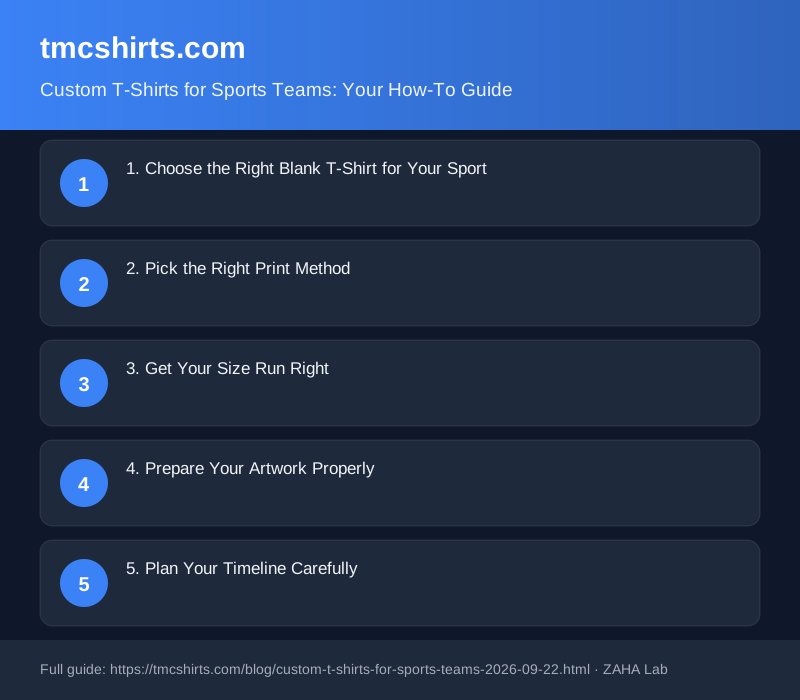
Most sports teams waste money on their first custom kit order — wrong sizes, the wrong fabric, or a print that cracks after three washes. Here is how to avoid every one of those mistakes.
1. Choose the Right Blank T-Shirt for Your Sport
The blank is the foundation of any team shirt, yet it is the decision most coaches and kit managers rush through. For contact sports — rugby, football, basketball — you want a shirt that breathes, wicks moisture, and does not stretch out of shape over a season. For casual team events, charity runs, or five-a-side nights, a mid-weight cotton tee is usually the better choice: it feels more premium, takes printed colour beautifully, and squad members are far more likely to wear it outside of the game.
As a general rule:
- 100% polyester or poly-blend — best for active sport; moisture-wicking, lightweight, quick-drying
- 180 gsm ring-spun cotton — ideal for training tops, supporter wear, and charity events; soft hand-feel, excellent print surface
- 50/50 poly-cotton — the compromise choice; slightly less vibrant print colour but very durable and budget-friendly across large runs
A go-to option for clubs ordering in bulk is the Gildan Softstyle Adult T-Shirt multipack — a 150 gsm ring-spun cotton blank that screen-printers use across the UK industry, available in a wide colour range, and very kind to tight team budgets.
2. Pick the Right Print Method
Not all printing is equal, and the wrong method for your order size or fabric type can cost you significantly. Here is a quick breakdown of the three most common techniques used for team orders in the UK.
Screen Printing
The gold standard for orders of 20 shirts or more. Ink is pressed through a mesh stencil directly onto the fabric, producing vivid, durable results that last hundreds of washes. Setup costs — burning the screens — make it expensive below a certain quantity, but the per-shirt cost drops sharply with volume. Best for: sports clubs, school teams, and charity events with a fixed design.
Direct-to-Garment (DTG)
A digital process that works essentially like an inkjet printer on fabric. There is no setup cost, it handles full-colour photography or complex gradients, and it is perfect for small runs of 1–19 shirts. The trade-off is a slightly softer print feel and a higher per-unit cost compared to screen printing at volume. Best for: one-off squads, trial kits, or coaches' polos with photographic artwork.
Heat Transfer Vinyl (HTV)
Individual shapes or text are cut from coloured vinyl and heat-pressed onto the shirt. It is the method of choice for numbering and individual player names because each shirt can be personalised cheaply without additional screen costs. If your club wants to handle the name-and-number stage yourselves, a roll of Siser EasyWeed Heat Transfer Vinyl and a basic heat press will handle it cleanly at home — the material is forgiving to apply and highly wash-durable.
3. Get Your Size Run Right
Sizing is the most common source of complaints after a team order arrives. Crew-neck tees vary between brands — a Gildan Large fits quite differently from a Fruit of the Loom Large — so always request a sample garment or check the manufacturer's chest measurements in centimetres before committing.
A reliable method: send every squad member a simple form (Google Forms works perfectly) asking for their chest measurement, then map those numbers to the brand's official size chart. Do not ask people to self-report a size letter — they will almost always underestimate, and you will end up with a pile of smalls that no one wants.
Also build in a size buffer. For a squad of 15–20, ordering two or three extra mediums and larges costs very little at bulk pricing and saves considerable hassle for latecomers, new sign-ups, and inevitable replacements. For a cost-effective way to check fit across different sizes before your main order lands, a Fruit of the Loom Original T-Shirt 5-Pack lets you sample several sizes in one purchase.
4. Prepare Your Artwork Properly
Printers need vector files — AI, EPS, or a high-resolution press-ready PDF — for screen printing. For DTG, a 300 dpi PNG with a transparent background is the accepted minimum. Sending a club crest exported from a website at 72 dpi will produce a blurry result regardless of how skilled the printer is.
A few practical rules before submitting artwork:
- Convert all text to outlines so the printer does not need your specific fonts installed
- Keep logos to no more than three or four spot colours for screen printing — each additional colour means an extra screen and an extra cost
- Agree a print placement mockup before going to production and get it signed off by whoever is paying — it prevents expensive reruns
- Specify Pantone references for your club colours rather than relying on on-screen RGB values, which vary widely between monitors
If your club does not have a vector version of its crest, a local graphic designer or freelancer will typically re-draw it for £25–£50. Pay for it once and store the file somewhere reliable — you will need it every season.
5. Plan Your Timeline Carefully
The single biggest mistake teams make is leaving the order too late. Screen printing involves artwork approval, screen creation, print runs, and quality checks — most reputable UK suppliers need 10–15 working days from artwork sign-off, and that assumes no revisions. DTG and HTV orders can turn around in 3–5 working days, but relying on that for a pre-season kit deadline is a gamble you do not need to take.
Work backwards from your first match or event date, subtract a full week as a contingency buffer, and place the order by that date. For leagues with a fixed start date in September, placing your order in early August is not overcautious — it is simply sensible planning. Rush charges from print suppliers are avoidable costs that eat into every other saving you have made.
FAQ
How many custom t-shirts should I order for a sports team?
For a standard football or rugby squad, order one shirt per player plus 10–15% extra for substitutes, new sign-ups, and replacements. A squad of 20 typically warrants 23–24 shirts. Screen printing becomes cost-effective from around 20 units, so plan your order size around that threshold if your budget allows.
What is the cheapest way to get custom t-shirts printed for a team?
Screen printing on a poly-cotton or 100% cotton blank is usually the lowest per-shirt cost once you reach 25 or more pieces. DTG has no setup cost but costs more per unit. For very small groups of under 10, heat transfer vinyl applied with a home heat press is often the most economical option — especially for personalised names and numbers.
Can I put individual player names and numbers on custom team t-shirts?
Yes — heat transfer vinyl or individual screen-printed overlays are both common methods. HTV is the most flexible option because each shirt can be personalised independently without incurring additional screen costs. If your supplier offers sublimation printing on polyester garments, individual names and numbers can sometimes be included in the base print at no extra charge.
How do I choose the right colours for my team's custom t-shirts?
Start with your existing club colours if you have them. If starting from scratch, choose a maximum of two main colours that contrast strongly — one for the shirt body, one for the printed design. Always check how the print colour reads at distance rather than just on screen, and ask your printer for a Pantone-matched colour reference to ensure consistency across future reorders.
What file format should I send to a custom t-shirt printer?
Vector files — .ai (Adobe Illustrator), .eps, or a press-ready PDF — are the professional standard and will produce the sharpest results for screen printing. For DTG, a high-resolution PNG at 300 dpi with a transparent background is acceptable. Never send a logo scraped from a website — the resolution is almost always too low for a clean, crisp print result.
Related Products
Useful kit for clubs ordering or managing their own custom team shirts: