Team T-Shirt Costs Explained: What Affects Your Price
Many teams are shocked when they see the final invoice for custom t-shirts. The price rarely matches their initial guess.
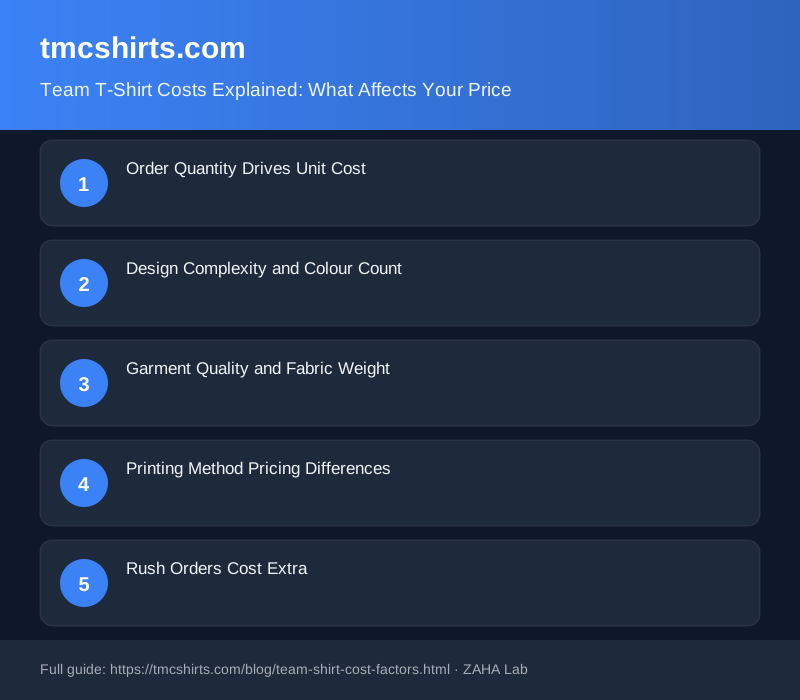
The cost of custom team t-shirts depends on five key factors: order quantity, design complexity, garment quality, printing method, and turnaround time. Understanding each will help you budget correctly and avoid overspending on your next team event.
Order Quantity Drives Unit Cost
The biggest factor affecting your price per shirt is how many you order. A 50-shirt order costs far more per unit than a 500-shirt run. Bulk discounts kick in at different thresholds depending on your supplier, but the pattern is always the same: more shirts equal lower unit cost.
Most printers offer tiered pricing. Ordering 25 shirts might cost £12 each. Jump to 100 shirts and the price could drop to £8.50. At 500 shirts, you might pay £5.50 per unit. This compounds across your total order, so planning ahead saves real money.
Design Complexity and Colour Count
Screen printing charges based on the number of colours in your design. A single-colour logo costs significantly less than a full-colour front and back design. Each additional colour adds preparation time and ink costs.
DTG (direct-to-garment) printing doesn't have this limitation in the same way. You can print photographic designs without the colour surcharge, but DTG typically costs more per shirt than screen printing for simple logos. If your design has 1-3 colours, screen printing wins on price. For full-colour or photo designs, DTG often offers better value.
Garment Quality and Fabric Weight
Not all t-shirt blanks cost the same. Budget 150gsm cotton shirts are cheaper than premium 200gsm options. Heavier, denser fabric feels better and lasts longer, but you'll pay more upfront. Consider whether your team needs shirts that survive repeated washing or if a basic option suffices.
Fabric blend also affects cost. 100% cotton runs cheaper than cotton-polyester blends. Organic cotton costs more still. For event shirts your team might wear once, basic cotton works fine. For permanent team uniforms worn regularly, investing in quality fabric justifies the extra cost.
Printing Method Pricing Differences
Screen printing has high setup costs but low per-unit costs once you exceed 50 shirts. Heat transfer has minimal setup but costs more per shirt. Embroidery is the priciest option. For team orders of 25 or fewer, heat transfer might be cheaper. For 100+ shirts, screen printing wins.
You can compare quotes from suppliers like TMK Shirts to see exact pricing for your specific order. Most offer instant quote tools where you input quantity, design colours, and garment details.
Rush Orders Cost Extra
Standard turnaround is usually 5-10 working days. Rush orders completed in 2-3 days incur premium pricing, sometimes 30-50% above standard rates. If your event date is weeks away, ordering early locks in normal pricing. If you need shirts in days, budget for the rush fee.
FAQ
How much should I budget per shirt for a team order?
Budget £5-£10 per shirt for screen printing on bulk orders (100+), £8-£15 for smaller quantities (25-99), and £10-£18 for rush orders. Premium quality or embroidery pushes costs higher. DTG and heat transfer fall in the £8-£12 range depending on design complexity.
Does fabric choice really affect the final cost?
Yes, significantly. Premium 200gsm fabric costs 20-40% more than basic 150gsm options. For event shirts worn occasionally, the difference doesn't justify the cost. For team uniforms worn regularly, better quality reduces replacement costs long-term.
Can I lower costs by splitting my order across suppliers?
Not usually. Splitting quantities works against you. Each supplier's bulk discount thresholds apply only to orders with them. A 100-shirt order at one supplier is cheaper than two 50-shirt orders at different suppliers.
What's the minimum order quantity?
Most suppliers accept orders as small as 12-25 shirts, but unit costs are highest at these volumes. Minimum order requirements vary by supplier and printing method, so ask before finalising your design.
Is it cheaper to order white shirts for all and print designs on coloured shirts?
Not necessarily. Printing on a dark shirt costs the same as a white one if using the same method. Bulk discounts on blank garments mean ordering one colour in quantity beats ordering many colours in small volumes. Stick with one or two shirt colours for best pricing.
Related Products
Durable 200gsm blank shirts perfect for team orders and lasting quality.
For testing designs or small batches before committing to bulk printing.
Measure shirt quality to compare suppliers and garment specifications accurately.
Affiliate Disclosure: This post contains affiliate links to Amazon UK. We earn a small commission if you purchase through these links, at no additional cost to you.