Screen Printing vs Heat Transfer for Team T-Shirts
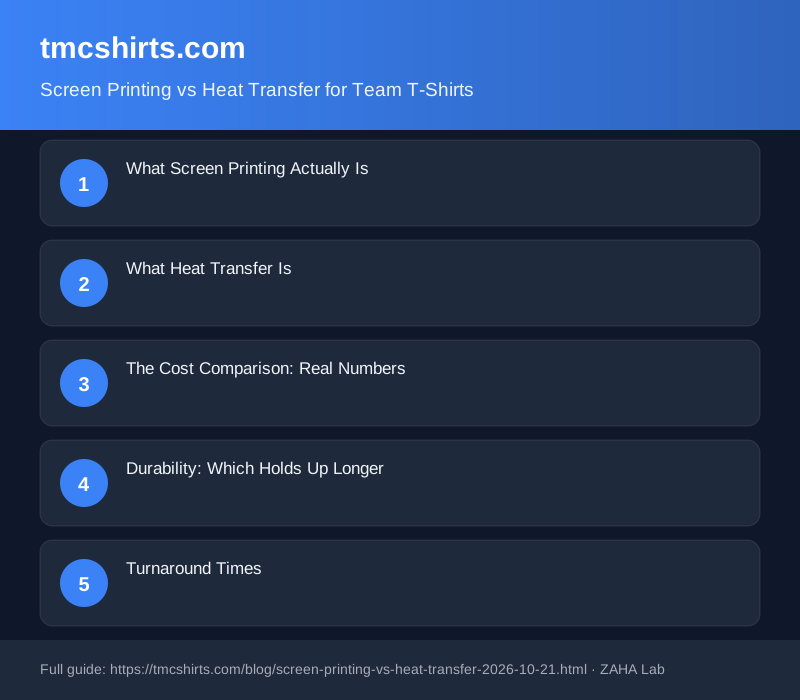
Choose the wrong printing method and your per-shirt cost jumps by 40%, or the print starts peeling before the season ends. Here is what actually determines the right call for your order.
What Screen Printing Actually Is
Screen printing forces thick ink through a fine mesh stencil directly onto the fabric. Each colour in the artwork needs its own screen, which adds a setup charge of roughly £15 to £30 per colour. Once those screens exist, the cost of printing one more shirt is almost negligible.
The ink bonds into the fabric fibres rather than sitting on top. Washed inside-out at 30°C, a well-printed screen print survives 60 or more cycles without significant fading. That durability is why sports clubs and corporate teams return to it year after year.
What Heat Transfer Is
Heat transfer bonds printed material to the fabric using a heated press at around 150°C. Two methods cover most team and event needs.
- Vinyl (HTV): Cut shapes pressed onto the shirt. Clean edges, solid colours, the standard for squad numbers and names.
- Direct-to-film (DTF): A full-colour print transferred from a film carrier. Handles photographs, gradients, and complex artwork with no per-colour setup charge.
No screens means no setup fees. A design with six colours costs no more to apply than one with two, whether you are printing a single shirt or a dozen.
The Cost Comparison: Real Numbers
Take a concrete example: 48 shirts, three-colour chest logo, printed front only.
| Method | Setup cost | Per-shirt cost | Total (48 shirts) |
|---|---|---|---|
| Screen printing | £60 (3 screens) | £4.50 | £276 |
| Heat transfer (DTF) | None | £7.50 | £360 |
Screen printing saves £84 on 48 shirts. Flip that to 10 shirts: screen setup costs £60, plus £45 print = £105 total, against £75 for DTF. The crossover for most UK suppliers sits between 20 and 24 shirts.
Blank t-shirt choice affects print quality and overall value. The Gildan Heavy Cotton T-Shirt, available in multipacks on Amazon UK, is a standard choice for professional screen printing because its 185 g/m² weight takes ink cleanly with no bleed-through on either print side.
Durability: Which Holds Up Longer
Screen-printed plastisol ink bonds into the fabric rather than forming a surface layer. Under typical laundry conditions, it outlasts the shirt itself. A club kit used every weekend for two seasons will show more wear in the collar and hem than in the print.
Heat transfer film sits on the fabric surface. Premium DTF transfers are tough and rated to 40-50 washes when cared for properly. Budget vinyl transfers begin lifting at edges after 15 to 20 cycles, especially on garments that flex during sport.
For an event t-shirt worn three times then retired, this distinction is irrelevant. For a football squad wearing the same shirt twice a week in training and matches, screen printing is the clear choice if the design allows it.
Turnaround Times
Standard screen printing orders take 7 to 10 working days from artwork approval. Screen preparation cannot be bypassed, and rush options typically add 25 to 40% to the base price for a 3-day turnaround.
Heat transfer orders are faster. A DTF run of 20 to 30 shirts ships in 3 to 5 working days with most UK suppliers. Local print shops offering heat transfer vinyl such as Siser EasyWeed (on Amazon UK) can sometimes complete single-item orders the same day. If the deadline is under a week, heat transfer is almost always the only practical option.
Fabric Types and When That Changes Everything
Both methods work well on 100% cotton and cotton-polyester blends. Screen printing performs poorly on nylon and technical stretch fabrics because the ink cannot bond into synthetic fibres properly. For moisture-wicking polyester sportswear, heat transfer or dye sublimation is the correct approach.
Sublimation is worth a separate mention for all-over designs. It produces no surface texture because the dye integrates into the polyester fibre itself. The catch: it only works on light-coloured polyester. Dark or cotton garments are not compatible.
For general team and event use, a cotton-rich blank in the 180 to 200 g/m² range is the standard choice. Fruit of the Loom Classic T-Shirts in 5-packs are a cost-effective option for charity runs and one-off events where long-term wear is not the priority.
Six Questions to Ask Before You Order
Run through this list before contacting any supplier:
- Quantity: above or below 20 shirts? That single number determines the likely cheaper method.
- Colours in the artwork: more than 4 spot colours make screen setup expensive and push the break-even point higher.
- Deadline: under 7 working days means heat transfer by default.
- Fabric type: technical polyester sportswear needs heat transfer or sublimation, not screen printing.
- Wear frequency: kit used twice a week benefits from the durability of a quality screen print.
- Individual names or numbers: always use heat transfer vinyl or DTF for personalisation, regardless of order size.
FAQ
What is the minimum order quantity for screen printing?
Most UK printers set a minimum of 12 to 24 shirts. The screen setup cost is only economical when it is spread across enough units. Some suppliers will print below that threshold but charge a small-run surcharge that effectively erases the per-unit saving.
Can I add individual names to screen-printed shirts?
Each individual name would require its own screen, which is not economical. The standard practice for teams is to screen print the base design across the full run, then apply individual names and squad numbers separately using heat transfer vinyl. Many printers offer this as a combined service.
How many washes does a heat transfer typically last?
A quality DTF or premium vinyl transfer lasts 30 to 50 wash cycles when the shirt is turned inside-out and washed at 30°C or below. Budget vinyl can start lifting at edges after 15 to 20 washes. Screen prints on 185 g/m² cotton typically outlast the garment itself under the same care conditions.
Which method works better on black or dark t-shirts?
Both methods handle dark fabrics, but approach it differently. Screen printing lays down a white underbase before the colour layers, which adds one screen to the setup cost. DTF transfers print the white as part of the carrier film, so dark shirts require no extra step or surcharge. For bold single-colour logos on black shirts, the visual result is comparable from either method.
What file format should artwork be in for each method?
Screen printing suppliers need vector artwork: an.ai or.eps file, or a high-resolution PDF at 300 dpi minimum. For heat transfer orders, a PNG file with a transparent background at 300 dpi is standard and accepted by almost all DTF suppliers. Never send a logo saved from a website; resampling a 72 dpi file to 300 dpi does not recover detail.