How to Order Custom T-Shirts for a Sports Team
Over 40% of first-time bulk shirt orders arrive with at least one sizing error. For a 30-person squad, that is 12 players standing on the touchline in shirts they cannot wear.
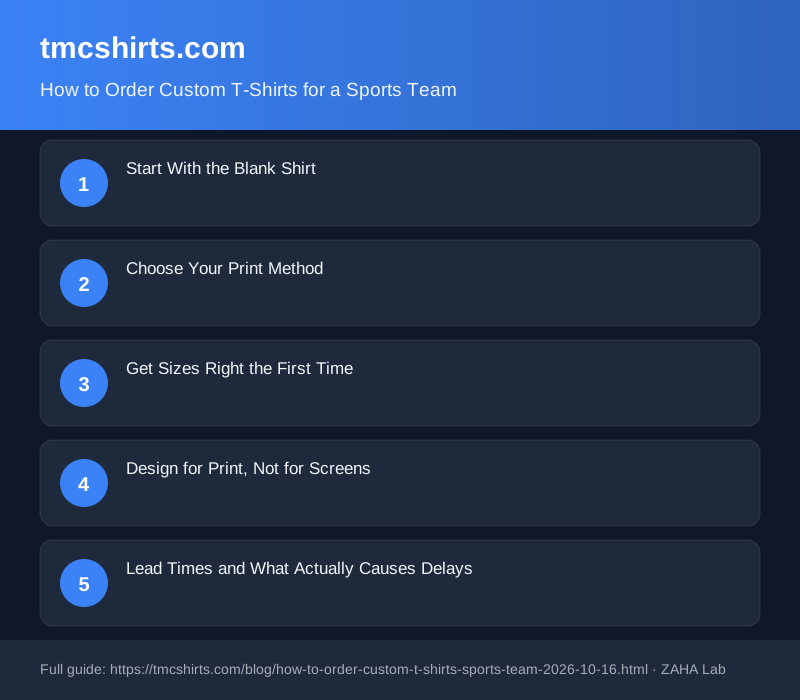
Start With the Blank Shirt
The blank is the decision that shapes everything else. Print method, wash durability, and cost per unit all follow from the fabric weight and construction. Get this wrong and even flawless artwork looks amateur by week four of the season.
For active teams, 180 to 200 gsm is the practical range. Light enough for training in warmer months, heavy enough that screen print ink does not crack at the seams after repeated washing. Drop below 160 gsm and the plastisol ink used in screen printing tends to separate from the weave within 10 to 15 washes. Go above 220 gsm and you are paying for near-sweatshirt weight fabric in a summer kit.
Two blanks dominate UK team orders. The Gildan 5000 Heavy Cotton sits at 185 gsm, runs true to size across all fits, and is available in 64 colours from XS to 5XL. At 50 units the per-shirt cost drops to around £2.80. It is consistently in stock, which matters when a player joins late and you need one extra shirt in a specific size a month after the main order.
The Fruit of the Loom Valueweight 61-036 runs lighter at 165 gsm. That suits charity runs, summer tournaments, and one-off event shirts where breathability matters more than long-term print durability. At 50 units it typically undercuts the Gildan by 30 to 40p per shirt. Do not use it for a club kit you plan to wash twice a week for eight months.
For mixed-gender squads, order a fitted women's cut in the same brand rather than just sizing down a unisex shirt. The difference in fit is visible at 20 metres. Keep the blank consistent across the squad and the kit looks like a kit.
Choose Your Print Method
Three methods cover almost every team scenario. Each has a minimum order threshold where it becomes cost-effective, and knowing which applies to your order size saves you from paying setup fees that make no financial sense.
Screen printing is cheapest above 24 units. Each colour in your design requires a separate screen, and setup typically costs £15 to £25 per colour. A two-colour crest on 50 shirts spreads that £30 to £50 setup across enough units that it becomes trivial per shirt. Below 24 units, you are often paying more in setup than in ink. Most club kits, race day shirts, and charity walks fall comfortably above this threshold.
Direct-to-garment (DTG) printing carries no setup cost and handles full-colour photography cleanly. It is right for small squads of 8 to 20 players, one-off commemorative shirts, or designs with gradients and photographic detail. The practical limit: DTG bonds best with pre-treated white or pale fabric. On a navy or black shirt, colours lose saturation. Expect per-shirt costs of £4 to £8 for a standard chest print at low quantities.
Heat transfer vinyl works well for personalisation after the main run. Print the club logo and sponsor by screen, then add squad numbers and surnames in heat transfer vinyl later. A compact heat press machine for in-house application runs from £80 to £200, which pays for itself after roughly 40 applications compared to outsourcing each name individually.
Get Sizes Right the First Time
Size collection is where most team orders fall apart. Someone forgets to ask the substitutes. A player guesses medium when they wear a large. The kit manager ends up with three XS shirts and a match the following Saturday.
Run a form. Google Forms takes four minutes to set up. Ask for chest measurement in centimetres alongside the size choice, because sizing varies by 2 to 3 cm between blank brands. Attach the size chart for the specific blank you are ordering. Do not assume players know what size they wear in Gildan.
Order a 10% buffer above your confirmed headcount. Thirty players means 33 shirts. The extra units cover late additions, sizing swaps, and the club sponsor who wants one in June when reprinting the full run would cost more than three shirts ever could. At £3 to £5 per shirt, three units costs less than a single rush reprint.
Set an internal collection deadline two full weeks before you contact the printer. Not one week. Stragglers are inevitable. If you promise the printer artwork and sizes on 1 November, your internal deadline to players is 18 October. That buffer absorbs the three people who reply two days late.
Design for Print, Not for Screens
Artwork problems cause roughly a third of all print delays. The most common: JPEG logos exported from a slide deck, RGB colour files submitted to a process that uses Pantone inks, and designs with fine detail that disappears below 3 mm in print.
Send a vector file wherever possible. AI, EPS, or SVG formats scale without any loss of quality. If your club crest only exists as a PNG, ensure it is at least 300 dpi at the size it will physically print. A logo that looks sharp at 96 dpi on screen prints blurry at 40 mm wide on fabric.
Simplify your design for screen printing. Every colour is a separate pass through the press. A four-colour design on a dark shirt requires a white underbase, making it effectively five screens. Standard pricing at most UK printers covers up to four colours. Beyond that, costs climb fast. The strongest club kits tend to use two or three spot colours, not eight.
Provide a Pantone reference for any colour that matters. "Navy blue" is a guess. Pantone 289 C is an instruction. The difference between a cohesive kit and a mismatched one often comes down to specifying one Pantone code clearly in the artwork brief.
Lead Times and What Actually Causes Delays
Ten working days is the standard turnaround for UK screen print orders. That is a calendar fortnight, not including weekends and bank holidays. Rush services exist but add 30 to 50% to the total cost. More importantly, they push you to the front of a queue that is already running at capacity.
The three most common delay causes are: artwork sent after the agreed deadline, size information arriving in batches over several days, and payment held up waiting for committee approval. Sort all three before the printer's cutoff, not after the first reminder email.
For orders above 200 shirts, allow 15 to 20 working days and confirm a production slot, not just a delivery date. Some printers take a 20 to 30% deposit to hold capacity. Pay it the day you confirm. The alternative is finding your slot given to an order that committed first.
September and the four weeks before Christmas are the busiest periods in UK garment printing. If your event falls in either window, book six weeks out. Waiting until four weeks before a November tournament is the single most reliable way to pay a rush premium.
FAQ
What is the minimum order for custom printed team t-shirts?
For screen printing, most UK printers set a minimum of 12 to 24 shirts. Below that threshold, setup costs make the per-shirt price uncompetitive. For DTG or heat transfer, some printers will handle a single shirt, though the per-unit cost is significantly higher than bulk rates.
How long does custom t-shirt printing take for a sports team?
Standard UK turnaround for screen printing is 10 working days from artwork and size approval. Rush services can reduce this to 5 working days but typically add 30 to 50% to the total order cost. Book earlier in September and the pre-Christmas period, when demand peaks.
What file format should I send for my team's logo?
Send a vector file: AI, EPS, or SVG. If you only have a PNG or JPEG, it must be at least 300 dpi at the final print size. Supply the Pantone reference for any colour that needs to match exactly. Artwork supplied at low resolution is the most common reason orders are delayed.
Can I order different shirt colours for one team?
Yes, but it increases cost if the design uses different ink colours on each shirt colour. Screen printing requires a separate underbase pass on dark fabrics. The cleanest approach is to settle on one or two shirt colours for the whole squad and split the print run, keeping the same screens.
Is screen printing or DTG better for a sports team?
Screen printing is better for squads of 24 or more, especially when the design uses solid spot colours and will be washed frequently. DTG suits small runs or designs with photographic detail, but wash durability is lower and results on dark shirts are less vivid than screen print on the same fabric.