How to Order Custom T-Shirts for Your Team
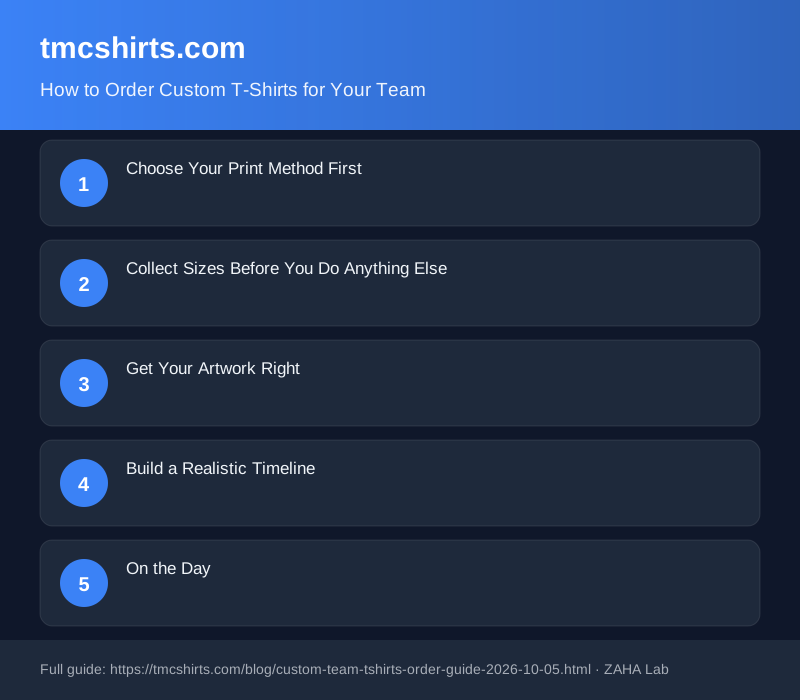
Three shirts never fit anyone. That is the average number returned after a typical team event order, and it happens every time sizes are collected at the last minute. The fix takes about five minutes of planning.
Choose Your Print Method First
The print method determines cost, lead time, colour options, and which garments you can use. Choose it wrong and you repay setup costs on a second run.
Screen printing forces ink through a mesh stencil directly onto fabric. Below 24 shirts the per-unit cost is hard to justify. Above that number, it is consistently cheaper than every alternative. Setup fees typically run £15 to £30 per colour, so a two-colour logo on 50 shirts lands somewhere between £6 and £10 per shirt including print. Wash durability is excellent and colours stay vivid after 50 washes. This is the standard method for sports clubs, charity runs, and corporate away-days.
DTG (direct-to-garment) printing works like a high-resolution inkjet printer, but for fabric. No setup fee, no colour limit, and no minimum order. The cost stays high on a per-shirt basis, so DTG makes financial sense at 30 units or fewer, particularly when artwork involves gradients or full-colour photography. At 50 units or more, screen print takes over on price every time.
Heat transfer vinyl (HTV) is worth considering as an add-on if you need individual names or squad numbers on the back. Most UK printers charge under £3 per name when it is added to an existing screen-printed order.
If you are sourcing blank garments to take to a local printer, Gildan Heavy Cotton T-Shirts are accepted by virtually every UK screen printer. The 180 gsm weight holds ink reliably, and the pre-shrunk cotton makes post-wash sizing predictable across a large order.
Collect Sizes Before You Do Anything Else
This is where most team orders go wrong. Someone says they will get sizes to you, then disappears for two weeks.
Open a Google Form the moment your design is approved. Give people exactly seven days to respond, then order without latecomers. That sounds harsh. It works. Every team that extends the deadline ends up placing two orders and paying for it twice.
A typical size spread for a mixed UK adult group of 30 people: 2 XS, 5 S, 9 M, 9 L, 4 XL, 1 XXL. Sports clubs skew larger. Primary school fundraiser orders skew smaller. Run your collected data against the printer's size guide rather than your own instincts about your group.
Order 8 to 10 per cent extra, weighted towards M and L. An event with 100 attendees needs at least 108 shirts in stock. Surplus gets sold, donated, or kept as spares. A guest who arrives in a shirt two sizes too small is not something you can fix on the day.
Fruit of the Loom Men's T-Shirts are available in multi-packs and make a practical backup option if you want stock on hand before the printed run arrives.
Get Your Artwork Right
UK printers see the same mistakes every week. A logo exported from Microsoft Word as a 72 dpi JPEG adds hours to a job and sometimes requires a reprint at full cost.
File format: Vector files (AI, EPS, or PDF with live paths) scale to any print size without degrading. If your logo was built in Adobe Illustrator, export it as an EPS with all fonts converted to outlines. If you only have a raster image such as a PNG, it needs to be at least 300 dpi at the final printed size. A logo that is 400 pixels wide looks sharp on screen and blurry on a chest print.
Colour mode: Screen printing uses Pantone (PMS) references. If a specific club or brand colour matters, include the Pantone code when you submit. DTG printers accept RGB files and handle conversion internally.
Safe zone: For a standard adult chest print, the usable area is roughly 30 cm wide by 35 cm tall. Ask your printer for their template before finalising the design. A design that looks centred on a mock-up can print off-centre on an XS and an XXL without proper placement guides.
Build a Realistic Timeline
Most UK printers quote 7 to 10 working days from artwork approval. That means a Friday event requires a submitted and approved order by the Monday 10 working days prior, with no revisions still outstanding.
| Step | Days before event |
|---|---|
| Finalise design and get sign-off | 21 days |
| Close the size collection form | 14 days |
| Submit order with confirmed artwork | 13 days |
| Confirm dispatch with the printer | 3 days |
| Unbox, check quality, sort by size | 1 day |
Rush services exist. They typically add 30 to 50 per cent to the total cost. Factor that into the budget now, while you still have time to avoid needing it.
On the Day
When the box arrives, pull one shirt out before opening the rest. Hold it against a white wall in natural light. Check that the print is straight and centred, that ink coverage is even, and that no colour is bleeding at the edges. Raise problems with the supplier immediately. You have very little leverage once you have opened a 100-shirt order at the venue.
Sort shirts into labelled bags by size the night before. It takes 15 minutes and saves that time twice over during a busy check-in or kit distribution.
Related Products
FAQ
What is the minimum order for custom team t-shirts?
Most UK screen printers require a minimum of 12 to 24 shirts per design. DTG printers often have no minimum, though cost per shirt rises steeply below 10 units. Some suppliers will print a single sample before you commit to the full run, usually at a small surcharge.
How long does custom t-shirt printing take in the UK?
Standard turnaround from artwork approval is 7 to 10 working days. Rush services can bring this down to 3 to 5 working days at a 30 to 50 per cent premium. Confirm lead times directly with your printer before you place the order, as times vary by supplier and season.
Can I mix shirt colours in one order?
Yes, and most printers allow it. Screen printing gets more complex when garment colours are mixed because ink opacity needs adjusting for each base colour. DTG handles mixed garment colours with no additional setup, making it worth considering if your team needs more than two base colours in the same run.
What file format should I use for my logo?
An AI or EPS vector file with fonts converted to outlines is the first choice. If you only have a raster image, submit a PNG at 300 dpi or higher at the intended print size. Avoid JPEG for any artwork with sharp edges or small text, as JPEG compression introduces visible artefacts at print scale.
Is there a standard size split for team t-shirt orders?
There is no universal rule, but a common starting point for a mixed UK adult group is approximately 5 per cent XS, 15 per cent S, 30 per cent M, 30 per cent L, 15 per cent XL, and 5 per cent XXL. Treat this as a cross-check against your collected data, not a substitute for it. Always collect actual sizes from your team.