Custom Event T-Shirts: Planning Bulk Orders
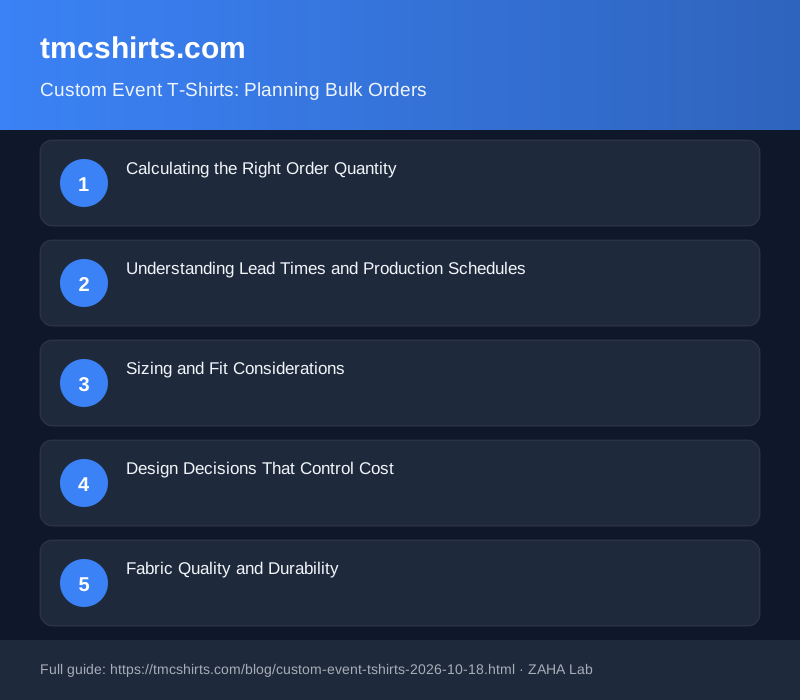
Event organisers frequently discover that ordering custom t-shirts too late means paying premium prices for rush production. Here's the essential guide to planning bulk custom t-shirt orders: decide quantities 8-10 weeks ahead, confirm your supplier's lead times within 12 weeks, and lock in designs 10-12 weeks before your event date. This approach typically saves 20-30% on costs compared to last-minute rushes.
Calculating the Right Order Quantity
The first step is working backwards from your expected attendance. Most event organisers add 10-15% buffer to their confirmed headcount. For a 200-person corporate away day, that means ordering 230-230 shirts. This buffer covers last-minute registrations, plus staff and crew who might not be formally counted.
Different events require different quantity strategies. A charity 5k run might expect 60-70% of registered runners to collect a shirt. A product launch where every attendee receives a branded shirt needs 100% coverage plus 10% extras. Sports tournaments need sizing across age groups, so factor in potential size imbalances: you might have 40 large, 45 medium, and 30 small shirts, rather than equal splits.
When in doubt, consult with your custom printer about industry norms. Many specialists, like those offering bulk printing services and design consultation, can advise based on your specific event type.
Understanding Lead Times and Production Schedules
Standard lead time for custom t-shirt printing is typically 3-4 weeks from order to delivery. Screen printing usually takes longer (up to 5 weeks for large orders) because each colour requires separate preparation. Direct-to-garment printing is faster (2-3 weeks) but works better for smaller orders under 50 units. Embroidery takes 4-6 weeks because production happens sequentially rather than in batches.
Add shipping time to your production estimate. Standard delivery within the UK is 3-5 business days. If your event is on November 22, and you need delivery by November 19, your order must be confirmed and paid by October 10 (accounting for 5 weeks production and 5 days delivery buffer).
Rush orders are possible but expensive. Expect to pay 40-60% more for 2-week turnaround. Very few printers offer 1-week service, and those that do charge substantially. Build in realistic timelines rather than hoping for exceptions.
Sizing and Fit Considerations
Choose a size run that matches your audience. Corporate events typically need adult sizes only (XS to 3XL, often weighted towards S-L). Children's events need youth sizes (4-16 years). Mixed audiences need both ranges, and this complicates logistics. One supplier might print adult and youth on different schedules, delaying your order.
Request a sample shirt before committing to the full order. Check the fit, feel the fabric weight, and verify that the print quality meets expectations. A single poor-quality sample can save you from ordering 300 disappointing shirts. Many custom printers offer samples for GBP 15-25 and credit that cost against your full order.
Communicate sizing expectations clearly. "One size fits all" unisex cuts often frustrate people who wear fitted or relaxed styles. Specify your chosen brand's fit model in your brief. Gildan, Fruit of the Loom, and B&C Collectables are the most common wholesale suppliers, each with subtly different sizing.
Design Decisions That Control Cost
Single-colour designs on single-colour shirts cost significantly less than multi-colour prints. A white shirt with black logo print costs roughly 40-50% less than a navy shirt with a 5-colour gradient design. If budget is tight, stick to 1-2 colours. If you need colour complexity, screen printing (despite its longer lead time) often costs less than direct-to-garment for orders above 100 units.
Front-only prints are the cheapest option. Add a back print, and costs rise 20-30% because production complexity increases. All-over prints (front, back, sleeves) roughly triple the unit cost and require specialist DTG equipment.
Keep artwork simple and high-contrast. Fine details, thin lines, and small text don't survive printing, especially on textured fabrics. Your designer should understand these technical limitations. Tools like professional design software and templates help create print-ready artwork that reduces revision rounds.
Fabric Quality and Durability
Cheap blank shirts (sub-GBP 2 per unit) thin out after 5-10 washes. Mid-range blanks (GBP 2.50-4 per unit) last 20-30 washes. Premium options (GBP 4.50+ per unit) last 50+ washes. For one-time event shirts, mid-range usually suffices. For team uniforms worn repeatedly, invest in better blanks.
Cotton feels better and ages well, but shrinks 3-5% if your audience washes in hot water. Polyester blends (65% cotton, 35% polyester) resist shrinkage and feel more structured. 100% polyester dries faster but doesn't breathe as well in warm weather.
Weight matters. 160gsm (grams per square metre) is lightweight and suitable for summer events. 180gsm is standard and works year-round. 200gsm+ is heavy and warm, best for winter or outdoor endurance events. Heavier shirts cost more but convey higher quality.
Handling Inventory After the Event
Leftover shirts happen. Plan what to do with extras before the event. Some organisers donate to charity, others retain as merchandise for future events, and a few sell to recoup costs. Storage is the hidden cost: 50 unsold shirts occupy a small cardboard box for 6-12 months. Factor in storage space when deciding whether to keep stock.
If you order via an online platform, you can sometimes split your order across two deliveries (50% now, 50% three weeks later) based on initial registration numbers. This reduces overstock risk, though some suppliers charge a handling fee for split shipments (typically GBP 25-40).
Budgeting the Full Cost
A 250-unit order with mid-range blank shirts (GBP 2.50 per unit) and a two-colour screen print (GBP 1.75 per unit) costs roughly GBP 1,062.50 for shirts plus printing. Add design time (GBP 75-150 if you're not using a template), delivery (GBP 25-50), and a 10% contingency, and your real budget is GBP 1,250-1,300. That's GBP 5-5.20 per shirt all-in.
For budget events with smaller quantities (50 units), cost per shirt climbs to GBP 8-12 because setup fees and shipping are fixed. The economies of scale are real: doubling your order often reduces per-unit cost by 15-25%.
FAQ
What is the minimum order quantity for custom t-shirts?
Most screen printers require a 50-unit minimum order. Digital printers (DTG) sometimes accept orders as small as 10-25 units but charge premium pricing per shirt. Larger minimums like 150-200 units typically qualify for better per-unit pricing.
Can I order custom t-shirts in mixed sizes?
Yes. Most printers will split your order across sizes at no extra charge. Order 30 small, 40 medium, 50 large, and 30 extra-large from a 250-unit batch. Some printers charge a small handling fee (GBP 15-25) if you request more than three different size configurations.
Should I choose screen printing or direct-to-garment printing?
Screen printing suits large orders (100+ units) with simple designs and long lead times. Direct-to-garment printing suits small orders (under 100 units) with photo-realistic or multi-colour designs and shorter lead times. For most event orders (150-300 units), screen printing offers better value and durability.
How do I avoid ordering the wrong sizes?
Ask your printer for a size chart specific to your chosen blank shirt brand, then survey attendees at registration or via pre-event email. Many event platforms (Eventbrite, Meetup) allow custom questions that capture shirt size. Use that data to create a realistic size distribution, then add 5-10% extra in your most common sizes.
What happens if my design doesn't fit the t-shirt placement?
A good printer will flag design issues during the proof stage. Work with your supplier to resize, reposition, or simplify artwork before production starts. Never skip the proof approval step, even if it delays your order by 2-3 days. A poor print ruins the entire batch.